
Key Takeaways
- CMS is phasing out the Inpatient-Only (IPO) list, shifting hundreds of procedures to outpatient and ASC settings by January 1, 2029.
- Site-of-care decisions will shift from automatic rules to clinical judgment, driven by patient acuity, physician preference, and payer policy.
- Inpatient units will see rising acuity, not emptier beds, impacting ICU ratios, staffing models, and room design as lower-acuity cases move to outpatient settings.
- Flexible “in-between” capacity—like 23-hour stay units—will become essential to handle complications and bridge the gap between inpatient and outpatient care.
- Health systems must stress-test master plans and bed-need models now, since pre-2026 volume assumptions may overstate inpatient capacity needs and understate ambulatory demand.
For 25 years, Medicare’s Inpatient-Only (IPO) list has quietly shaped how we design hospitals. If a procedure was on the list, the answer to “where does this case happen?” was simple: an inpatient bed. That certainty is ending.
Centers for Medicare & Medicaid Services (CMS) is phasing out the IPO list over three years. Roughly 285 procedures—mostly musculoskeletal—came off in 2026. More than 600 more are proposed to roll off in 2027, across digestive, respiratory, urinary, endocrine, and other service lines. The final group, which contains approximately 800 of the most complex procedures, is scheduled to roll off in 2028, which means the list will be fully gone by January 1, 2029.
Removal from the list doesn’t mean these procedures must move outpatient. It means Medicare will pay for them as an outpatient procedure when the physician decides that’s clinically appropriate. That sounds like a small change, but for anyone planning healthcare facilities on a 10- to 20-year horizon, it’s a big one.

What Changes When the List Disappears
Site of care becomes a judgment call, not a rule. Every case that used to be automatically inpatient now depends on patient acuity, surgeon preference, payer rules, and how the organization is set up. Volume will move, but not evenly. It will be shaped by local market dynamics and physician alignment.
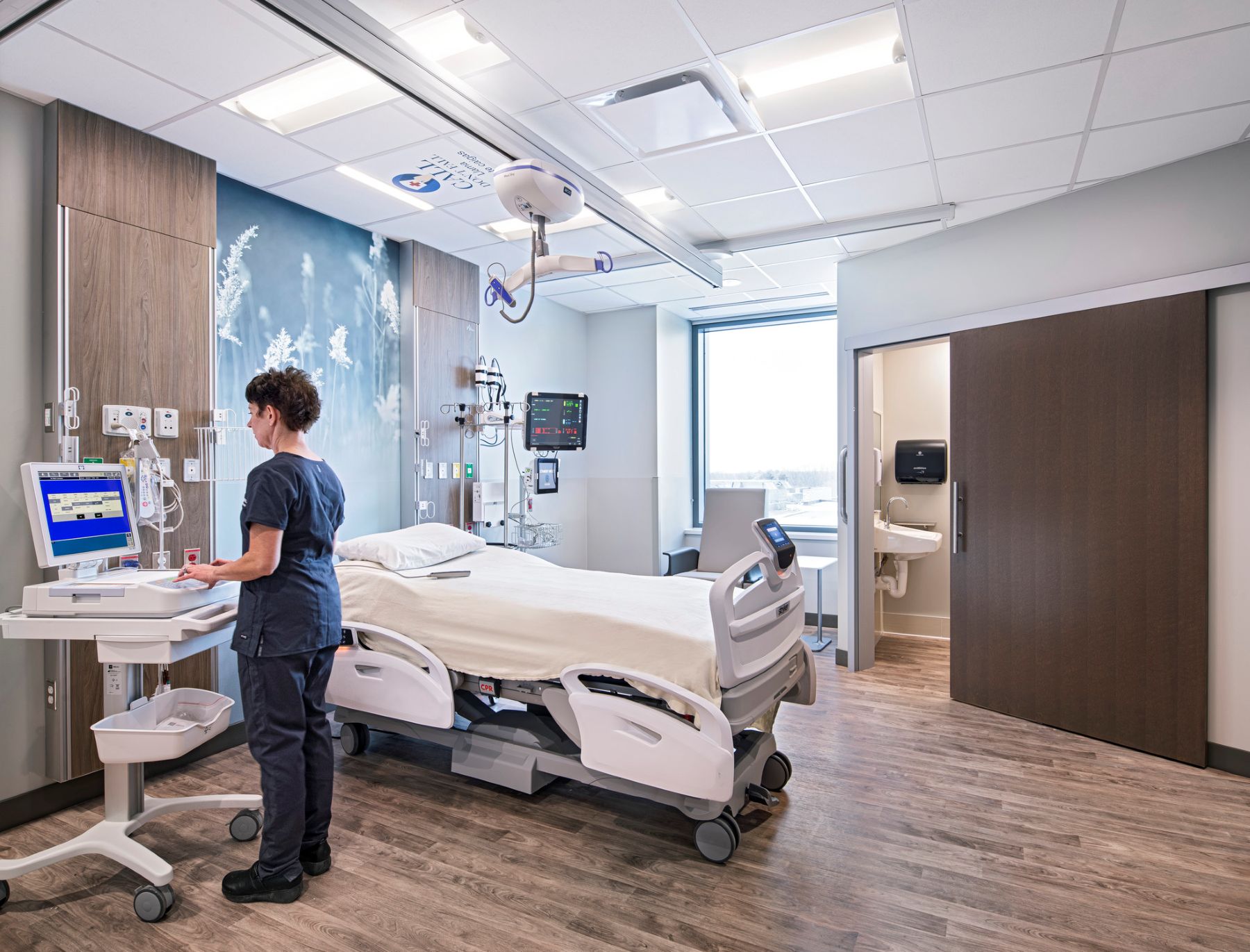
Inpatient beds get sicker, not emptier As lower-acuity surgical cases shift to hospital outpatient departments and ambulatory surgery centers, what stays in the tower is the most complex care. Bed counts may flatten, but acuity per bed rises. That affects ICU ratios, step-down capacity, room sizes, and staffing models.
ASCs and HOPDs absorb more complex work. CMS is adding hundreds of these procedures to the ASC Covered Procedures List at the same time. Ambulatory sites built for cataracts and scopes will be asked to handle longer, more complex cases with extended recovery. Many weren’t designed for that.
The “in-between” space becomes critical. Overnight recovery, 23-hour stay units, and flexible short-stay beds become the pressure valve. Consider a patient scheduled for a knee arthroscopy who develops complications mid-procedure—they may need an overnight stay. But does your facility have flexible beds ready, or only a choice between full inpatient admission or discharge? Organizations that planned only for “inpatient” or “outpatient” will feel the squeeze in the middle.
Payers won’t move in lockstep. Medicare Advantage and commercial authorization rules typically lag CMS. Expect a few years where the same procedure is outpatient-eligible for one payer and inpatient-only for another. Facilities need the flexibility to handle both. The silver lining: organizations that document clinical outcomes for these procedures in outpatient settings now will have data to negotiate favorable rates and authorization terms as payers align—turning a challenge into competitive advantage.
The Financial Reality
The reimbursement shift is material. For a health system performing 500 procedures annually on the IPO list, the revenue difference between inpatient Diagnosis-Related Group (DRG) payments and outpatient Ambulatory Payment Classification (APC) or ASC rates can represent millions in annual reimbursement variance. That’s not a line item to ignore — it’s a strategic pressure point.
Questions Every Health System Should be Asking Now
Is our master plan built on pre-2026 volume assumptions? Bed-need models that assume historical inpatient surgical volume may overstate tower capacity and understate ambulatory needs.
Where will displaced volume go, and who captures it? If your hospital doesn’t provide an attractive outpatient option, an independent ASC or competitor likely will. The risk of volume leakage isn’t theoretical— it’s happening now in markets where health systems haven’t invested in ambulatory surgical capacity.
Are our ORs flexible enough? Rooms and recovery areas that can move between inpatient and outpatient use protect capital against an uncertain shift.
What is the margin impact? Moving a case from an inpatient DRG to an outpatient APC or ASC rate changes revenue per case significantly. Facility strategy and financial strategy need to be modeled together.

The Bottom Line
The end of the IPO list doesn’t decide where care happens. It hands that decision to clinicians, markets, and the organizations that are prepared for it. The health systems that come out ahead will be the ones that treat 2029 as a planning event, not a billing update, and test their capital plans against a future where the line between inpatient and outpatient is drawn case by case.
How is your organization preparing? Reach out—I’m always interested to hear how others are rethinking capacity, ambulatory strategy, and flexibility as the list winds down.
Rob Hennes is Vice President of Health Strategy and Consulting at Gresham Smith. He has more than 15 years of experience guiding health systems, physician enterprises, and investors through complex strategic, financial and operational decisions to create long-term value.