
Note: This article first appeared in Medical Construction & Design.
Artificial intelligence has accelerated many aspects of architectural practice, with its most profound influence in design visualization. What began as experimental tools has quickly evolved into a creative ecosystem reshaping how architects ideate, communicate, and help clients envision future spaces. At Gresham Smith, we see AI not just as a productivity tool but as a catalyst expanding architectural expression’s boundaries.
For decades, visualization followed a predictable sequence: design a project, build a 3D model, render it, post-process, and present. AI has transformed this linear approach into a dynamic, iterative loop. Designers can now continuously test materials, lighting, massing, and narratives in real time. Instead of waiting hours or days, teams explore dozens of ideas in a single session. This shift goes beyond efficiency; it signals a fundamental rethink of how design decisions emerge.
From Renderings to “Theatrical Trailers” for Buildings
One striking change is AI’s democratization of high-end storytelling. Creating cinematic content once required film crews, special software, and weeks of editing. Now architects generate immersive, short “trailers” for buildings complete with mood, atmosphere, and narrative within hours because of AI visualization capabilities. This allows architects to think of themselves as directors, curating provocative stories of human experience.
No longer limited to static images or diagrams, we craft emotional arcs that let clients experience a future environment. For a recent high-profile medical center pursuit, our team used AI to create a fully realized world around the design, with contextual landscapes, animations, and human characters. The result wasn’t just a presentation but an experience that helped the client grasp our vision.
Material Palettes That Think With You
AI also revolutionizes material exploration; the traditionally time-consuming task of assembling physical boards and manually applying palettes to 3D perspectives. Today, AI instantly maps materials onto scenes, generating multiple variations showing how palettes behave under different lighting or spatial conditions.
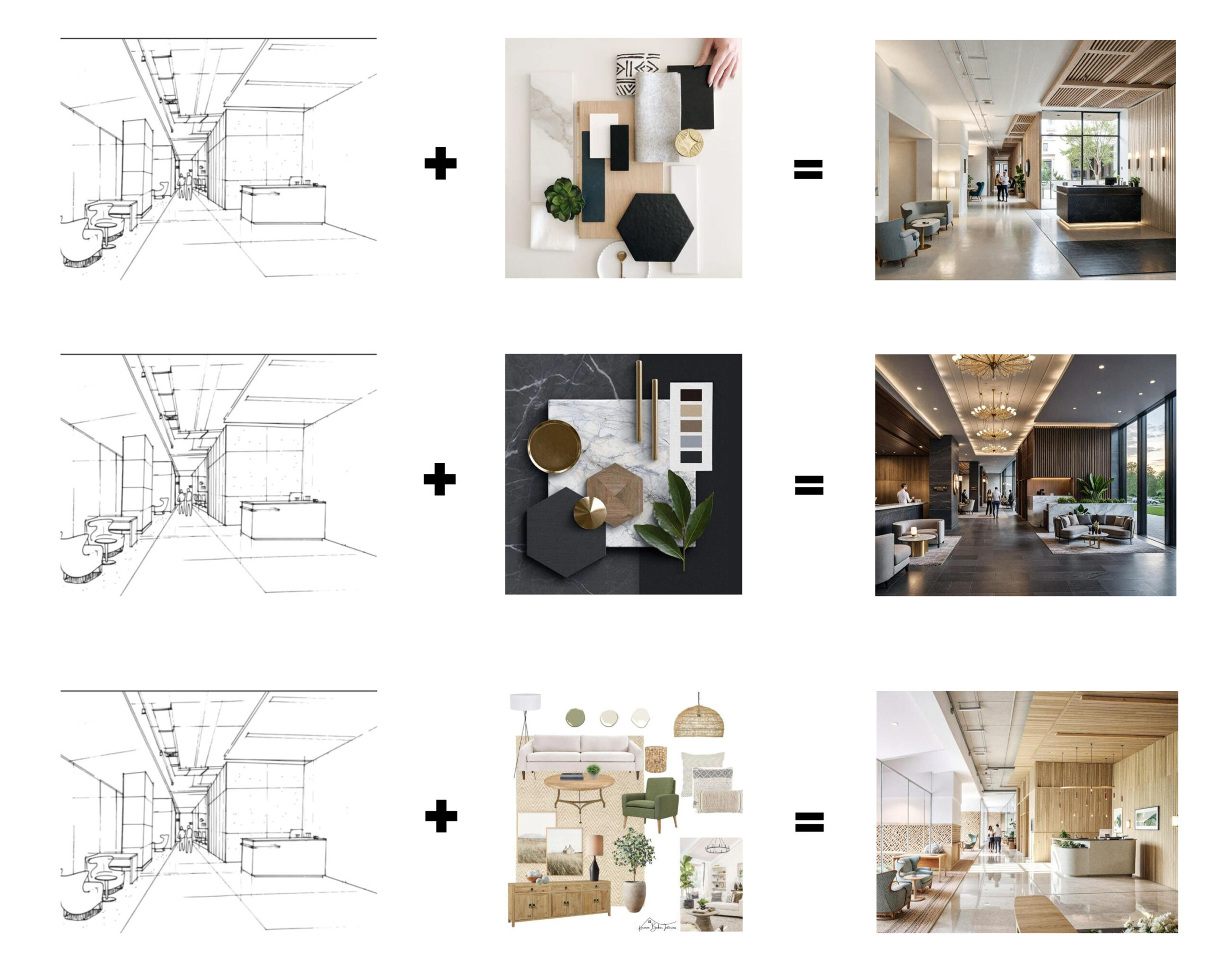
This process becomes collaborative and intuitive, like an optimized, design-literate mood board. Clients respond faster, designers test more options without detailed modeling, and teams make earlier, more confident decisions.
Humanizing Design Closes the Gap Between Architects and Clients
AI’s ability to populate designs with believable, context-specific characters is one of its most transformative and unexpected advances. These aren’t generic stock figures; they are tailored with biographies, roles, and, for healthcare, medical conditions influencing movement and experience.
For a recent medical center pursuit, our team created a cast of virtual users: nurses managing patient flow, patients navigating care pathways, family members seeking respite, and staff performing essential work. Each persona interacted differently, revealing operational nuances and emotional touchpoints traditional renderings cannot convey.


Seeing these characters in the design transformed the client experience. Instead of static images, they were immersed in a living, operational environment demonstrating empathy, workflow logic, and human experience. The design felt alive, dynamic, and purposeful, which helped the client not only understand but feel our vision.
This world-building is especially powerful in healthcare, where empathy and operational clarity are critical. We are using AI to bridge the gap between architectural intent and lived experience, allowing clients to see how a space functions for its users, not just how it looks.
Beyond personas, AI strengthens communication by helping architects and clients use a common language: narrative storytelling. Many decision-makers aren’t fluent in drawings or technical terms but respond immediately to stories, people, and environments that feel real. By generating fast iterations, immersive narratives, and contextual scenarios, AI reduces the cognitive distance between architects and clients. This encourages earlier feedback, clearer preferences, and more active client participation, which furthermore strengthens alignment and speeds consensus.
Cautious Optimism: Navigating AI’s Challenges
Despite its promise, AI requires careful management. Overreliance on AI-generated imagery risks unrealistic expectations. Ethical questions around representation, authorship, and data integrity demand vigilance. Rapid iteration can tempt teams to prioritize quantity over thoughtful refinement.
At Gresham Smith, we embrace AI with measured optimism as a tool that amplifies human creativity rather than replaces it. Success comes from intentional use by exploring possibilities and informing decisions instead of dictating solutions.
Just the Beginning
We’re still only scratching the surface of what AI-driven visualization can unlock, yet its early impact is already reshaping how architects imagine, communicate, and humanize the built environment. As these tools evolve, they won’t replace the intuition or judgment behind thoughtful design; they’ll extend it, giving architects new ways to translate complexity, reveal intent, and bring empathy forward in every decision. And if this is just the beginning, the future of visualization won’t simply help us design better buildings; it will open entirely new possibilities for the people and communities they’re meant to serve.