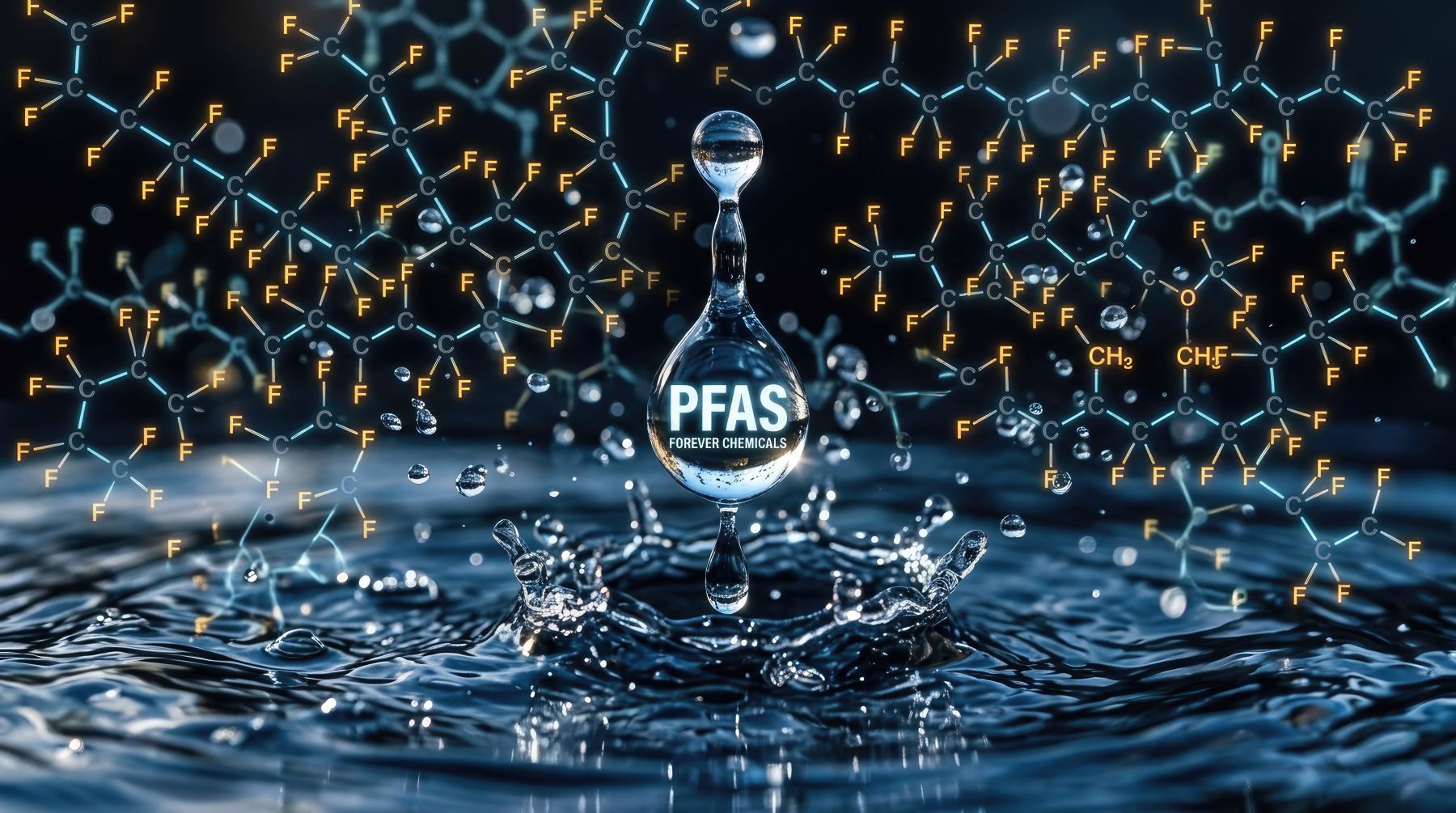
“Forever chemicals.”
I hate that nickname. But let’s be honest: to anyone on the front lines of water and wastewater treatment, it’s accurate. This is a current environmental problem due to a previous failure of foresight and a lack of shared information. It keeps me up at night.
Whether we know it or not, we’ve been living with PFAS for close to 100 years. Most of us have measurable amounts of PFAS in our blood and internal organs. They weren’t a secret or rogue invention, and they are amazing substances. They coat the pans in our kitchens, make the rain jackets in our closets waterproof, allow food wrappers protecting our meals to resist grease, and keep carpets in our houses stain-free. They are also essential components in industrial plating, cosmetics, and, critically, in the aqueous film forming foam (AFFF) used to fight fires at military air bases and commercial and private airports. They’re everywhere because they worked so well in so many applications.
Here’s the kicker, the design flaw that became a global calamity: they don’t burn, they don’t stick, and they don’t break down. That last part, the chemical stubbornness of that incredibly strong carbon–fluorine bond, is what turned these miracle molecules into a ubiquitous and recalcitrant environmental problem.
For years, the accepted playbook was straightforward: just pull them out of the water. Activated carbon, membranes, and ion exchange resins are all proven technologies for capture. But then what? You’re left holding a bag, sometimes literally, of highly concentrated PFAS waste. I remember a conversation with an engineer a few years ago who joked, “We didn’t solve the problem; we just made it smaller and angrier.” He was right. We haven’t solved the problem yet; we’ve just moved it to a different medium.
That’s why the real question for this industry is: how do we destroy PFAS?
And here’s the good news—the part that finally lets me sleep a little better at night: after years of this being nothing but “academic theory,” real, tangible destruction technologies are finally moving out of the lab and into the field. Some are running pilot projects that look like high-tech shipping containers. Some are scaling up, and a few are already knocking on the door of full-scale, commercial reality.
I’ve been tracking this research, and honestly, I’m excited about what I’m seeing. Below is a detailed breakdown of the most advanced PFAS destruction technologies.
Supercritical Water Oxidation (SCWO): The Nuclear Option
If you think of the PFAS molecule as a chemical tank, SCWO are the big guns. It’s a brute-force method, but it’s effective.
Here’s how it works: One forces water past its normal thermodynamic limits—hotter than 374 ℃ and pressurized over 3,500 psi (about 240 times atmospheric pressure). In that “supercritical” state, water isn’t a liquid or a gas; it’s a phase of matter somewhere between where water becomes non-polar. It becomes a super solvent that dissolves organic molecules, and critically, it allows oxygen to attack those molecules directly; including the strong C-F bonds of PFAS.
The chemistry is brutal but simple: the PFAS are oxidized completely. They are reduced to harmless components: CO2, water, and inert fluoride salts.
The upside: SCWO works. When engineers talk about it, they brag about 99.9999% destruction – the famous “six nines.” It’s the closest, most proven thing we have to a guarantee for highly concentrated waste streams like spent ion exchange resins, reverse osmosis rejectate, AFFF concentrates, and pure PFAS stocks. It achieves mineralization, meaning the molecules are completely broken down, not just turned into perfluoroalkyl-containing byproducts.
The downside: The intensity of the conditions is the problem. Running a reactor under those extreme conditions is expensive and has inherent safety issues. The vessels require exotic alloys to resist corroding in what is basically a high-pressure, high-temperature chemical pressure cooker. Additionally, keeping water that hot and pressurized eats fuel and increases costs.
My take: SCWO is closest to commercial reality with technology readiness levels (TRLs) approaching 9. I’ve seen pilot units that look like compact industrial plants, designed specifically to treat high-concentration liquids. They’re impressive, but you can almost hear the energy meter spinning from fifty feet away. It’s a beast, but the economics of treating large volumes of dilute municipal wastewater are still difficult to justify. It’s best suited for tackling the highly concentrated source of the problem.
Plasma Treatment: Lightning in a Tank
If SCWO is heavy artillery, plasma is shock and awe.
Plasma is often called the “fourth state of matter” that goes beyond solid, liquid and gas. To produce plasma for water treatment applications, a strong electrical discharge is run through or over the water’s surface. This discharge creates a storm of incredibly energetic electrons and radicals (like hydroxyl and atomic oxygen). These radicals are so reactive that they rip apart the recalcitrant C-F bonds.
The upside: Plasma operates at room temperature and normal pressure. That’s a huge operational advantage over SCWO; there is no need for those expensive, high-pressure reactors. In theory, you could roll out modular plasma units to treat contaminated sites on demand. Studies show anywhere from 50% to 90% PFAS removal, depending on the power and setup, making it flexible.
The downside: Plasma treatment reactors are an energy hog, even without the heat and pressure required for SCWO treatment. These reactors generate lightning, after all. The other massive challenge is volatilization. Sometimes, the PFAS don’t break down completely in the water; they jump into the gas phase. You’ve just moved the problem from water to air. That means an air treatment system is needed to capture and treat the gaseous PFAS, adding to the complexity and the cost of this technology.
My take: Plasma is flashy and flexible, but it’s not quite ready for the big leagues. Researchers have run falling-film plasma reactors where PFAS-laden water trickles down a surface while the plasma literally dances across it. But making that energy-efficient and reliable enough for continuous, municipal use is the core challenge. It’s a promising “middleweight fighter” but needs certain refinement to bring it to TRL 8-9.
Sonolysis (Ultrasound): When Sound Waves Attack
This is the technology that always raises eyebrows. When you tell someone that you’re destroying chemicals with sound, they look at you like you’ve been working too long.
It’s no fever dream: at very high frequencies (hundreds of kilohertz), sound waves passing through water create microscopic gas bubbles which ultimately collapse – a process called acoustic cavitation. When those bubbles compress and ultimately collapse, extremely high localized temperatures and pressures are the result. For a moment, inside and around the collapsing bubble, you get local hotspots hotter than 5,000 K and pressure measures over 1,000 atmospheres. That intense environment generates radicals that attack and destroy PFAS.
The upside: It’s somewhat surprisingly effective on the notoriously tough long-chain PFAS (like PFOS and PFOA). Some studies have even reported defluorination rates exceeding 100% (because the sonication broke down larger precursor molecules into more measurable short-chain PFAS before destroying them).
The downside: Cavitation is a chaotic phenomenon, and it’s very hard to control. Getting consistent, powerful bubble collapse across a giant treatment tank is immensely tricky and requires huge amounts of energy to drive the transducers. The energy bill is ugly, and the throughput is currently low. Therefore, scaling this technology should be a prominent research objective.
My take: Sonolysis feels like a technology straight out of a science fiction movie. I’ve seen laboratory demos where the water literally “sizzles” from the cavitation, and it’s mesmerizing. But scaling this technology to a city’s water or wastewater flow or a major industrial discharge? That’s a very long road ahead. It’s currently a powerful laboratory and bench-scale tool at TRL 4-6.
Electrochemical Oxidation: The Elegant Killer
Compared to the blunt instruments of heat or lightning, this one feels refined – almost surgical.
Electrochemical oxidation uses electricity and specialized electrode materials to mineralize PFAS. You flow the water between two plates – the electrodes – and pass current through them. At the anode, the PFAS molecules are directly oxidized and destroyed. It’s a clean surface reaction. The best systems use materials like boron-doped diamond (BDD), titanium oxides, or even new graphene-based materials. Add enhancements like electro-Fenton, and efficiency climbs even higher.
The upside: Lab tests consistently show greater than 90% PFAS destruction. The systems are modular, don’t need extreme heat or pressure, and are relatively simple to operate once running. You can turn them on and off as needed.
The downside: The electrodes themselves are the Achilles’ heel. They foul up with other organic matter in the water. They wear out overtime. And materials like BDD are expensive. The entire system is high-performing but high-maintenance. Furthermore, the process often works best at acidic conditions (low pH), which adds a pre-treatment or post-treatment operational complexity for municipal water and wastewater applications.
My take: Electrochemical oxidation is like a high-performance racecar. Sleek, but high-maintenance and expensive to run and repair. It’s a very strong contender for point-of-use or concentrated industrial streams, but the durability of the electrodes has to improve dramatically for wide-scale adoption in full-scale applications. This technology is likely at TRL 4-6.
Advanced Chemical Oxidation (ACO): Repurposing Existing Technologies
This is where the chemists pull out the heavy artillery already on the shelf.
Advanced Chemical Oxidation (ACO) involves powerful oxidants like persulfates, ozone, or iron-based Fenton’s reagent. You activate these oxidants using an energy source – often heat or UV light with a catalyst. When activated, they produce highly powerful, non-selective radicals (primarily the sulfate radical or hydroxyl radical) that are strong enough to break the C-F bonds of PFAS.
The upside: It works, often hitting 99%+ removal under the right conditions. And critically, we already use ACO widely in wastewater treatment for other contaminants. The infrastructure and expertise are already there, making it easier to sell utilities than other, lower-TRL technologies.
The downside: It’s powerful but finicky. PFAS don’t always mineralize completely. Sometimes, you trade the original PFAS for smaller, but still nasty, byproducts that are hard to track. Other components of the waste stream can also produce harmful byproducts. Chlorates, for example, can become a problem. It’s like using a chainsaw: incredibly effective, but you’d better know exactly what you’re doing, or you can make a bigger mess.
My take: ACO has its role, especially in tackling certain types of precursors for PFAS that are easier to break down. It’s a workhorse if tuned correctly, but it demands careful monitoring and process control. It’s not a magic bullet, but it’s a solid tool in the box, particularly for mid-concentration streams. Because of its previous applications to other non-PFAS waste streams and established chemistry in various matrices, TRL 4-6 is likely where this technology lives.
Photocatalysis: The Finishing Buff
If SCWO is the sledgehammer, photocatalysis is the finest-grit sandpaper.
Here, UV (or sometimes visible) light is an incident on a catalyst, often titanium dioxide (TiO2). The catalyst absorbs the light, which generates electron-hole pairs that trigger the slow, gentle, and sustained breakdown of PFAS. Researchers are tweaking this by doping the catalyst with metals or adding materials like graphene to boost performance.
The upside: This technology is low energy, relatively eco-friendly, and very efficient at low PFAS concentrations. It’s particularly great at polishing water that’s already been through a primary treatment step. Some systems even report greater than 90% fluoride recovery.
The downside: It’s too weak to be the main treatment process. It simply cannot handle heavy PFAS loads; the catalyst’s surface gets overwhelmed. It’s a low-rate process that requires a lot of light for a long period of time to work.
My take: Photocatalysis isn’t the frontline soldier. It’s the final cleanup crew, the polishing step you use at the end of a multi-stage system to guarantee that final level of purity. It’s great for PFAS-contaminated drinking water sources where the concentration is already low with regulatory limits even lower. This technology is likely at TRL 4-6.
Biological Treatment: Nature’s Slow Answer
And then there’s biology – harnessing natural processes for engineered solutions.
Scientists are testing specific microbes, fungi, and plants (i.e., bioaccumulators) to see if they can slowly metabolize or simply absorb and isolate PFAS. Bioelectrochemical systems have shown promise, achieving greater than 60% removal in controlled laboratory settings by enhancing microbial activity.
The upside: It’s cheap, sustainable, and perfectly eco-friendly. It leverages natural processes and minimizes energy and chemical use. Biological treatment is a frontrunner of green chemistry in remediation.
The downside: Reaction kinetics are low. Remember, PFAS were literally designed by chemists to resist biological attack, so they wouldn’t break down during use. You are fighting millions of years of chemical design here. The organisms struggle to break the C-F bond, and many of the mechanisms are still under intense investigation.
My take: Biology won’t win this fight alone. It’s currently too slow and too limited. But as part of a polishing step or a sludge digestion system in a hybrid train, it definitely has a sustainable role to play. TRL is likely 1-3 for this technology.
Pulling It All Together: It’s a Relay Race, not a Duel
Here’s the lesson I’ve learned from watching this field for the last decade: no single technology will solve the PFAS problem across all environments. This isn’t about finding one perfect machine; it’s about optimizing a treatment train. Each technology has a role that plays its strengths and mitigates the others’ weaknesses.
- SCWO is a heavy hitter for concentrated waste.
- Plasma and electrochemical treatments are the flexible middleweights for certain mid-concentration streams.
- Sonolysis and ACO are powerful but situational.
- Photocatalysis and biological treatment are the polishers.
The most exciting, and most realistic, development happening right now is the focus on engineering treatment trains for PFAS destruction; a relay race, not a duel. Pilot projects are already testing these exact relay races in the field. This sequenced approach has the potential to drastically lower the cost and energy requirements for each individual treatment step.
What’s Next: The Hurdles to Commercial Reality
So, where do we go from here? The science is proven, but the engineering challenge is steep.
- SCWO is closest to commercial reality, particularly for industrial waste. But we need to aggressively drive the energy and material costs down to make it more widely applicable.
- Electrochemical and plasma treatments are scaling up fast. Their biggest hurdles are durability (the expensive electrodes) and optimizing the energy-per-liter consumed.
- Sonolysis and ACO are still carving out their niches—likely as powerful, but specialized, pre-treatment steps.
- Photocatalysis and biological treatment are cemented as essential polishing steps, but their utility is limited to low concentrations.
The real challenge now isn’t inventing a new machine; it’s scaling existing technologies to a level that makes them effective at full-scale. It’s turning these cutting-edge, expensive demos into everyday tools that utilities can afford to build, operate, and maintain for decades. And that requires massive collaboration: researchers sharing data, engineers optimizing design, regulators setting realistic but firm standards, and utilities committing the capital.
Final Thought: Nothing is Truly Forever
PFAS got the nickname “forever chemicals” because they were built to last. They were designed by brilliant chemists to beat fire, grease, time, and nature itself. It was an effective product that created an environmental catastrophe.
But nothing, truly nothing, is forever.
We are proving that, right now, with heat, with lightning, with sound waves, with electrodes, with light, and yes, even with living organisms. The solutions aren’t simple; they’re complex and expensive, but they’re rapidly evolving.
The faster we determine how to combine them into smart, affordable, and durable systems, the sooner we can stop talking about “forever chemicals” and put PFAS where they belong: in the past. That’s the only way I’ll finally get a good night’s sleep.
Be sure to check out Part I, Part II and Part III of this series on PFAS!